
The Trans-Atlantic Slave Trade had been forbidden by Congress in 1907, but this made the domestic trade even more important and by 1789- 1865 we learn more than a million Americans born slaves were sold in the South. In Charleston, Slaves were mainly sold outdoors until after so many complaints the city band these outdoor sales in 1856. Some of these slaves were on the ship The Enterprise’ which saw 78 slaves arrive here and be assisted by the Friendly Society Association tn the courts to gain their freedom, all but one woman and her 5 children accepted the offer for freedom and to remain here in Bermuda. Her name was Matilda Ridgley.(see our Enterprise Exhibit). It was once asked of me as the museum curator why would she refuse her freedom and my reply was she may very well have left a husband back in the South and it was her desire to try to reunite her family. Several of the slaves of the Enterprise married and became apart of the organization that helped them to gain their freedom. Much history has evolved since then and we need to tell our slave stories. Bermuda will in a few days reach a mile stone when it unveils the name Mary Prince as a hero for this year. This is long over due and the committee needs all the congrats for doing this. Mary who took her father’s name Prince is a story to be told over and over again she was indeed a strong, brave and exceptional woman— a Hero. The suffering she endured and so many like her afforded us some of the freedoms we have today. The Bermudian Heritage Museum of Black history has told the story of Mary Prince in an exhibit since 1998 and in many other ways in Skit and Play form. We have recently done even more in dept research on Mary Prince and invite you to visit us and learn of Mary and many other slave stories. They are our true heroes.
More interesting Historical Facts.
Very often the Friendly Societies have been accused of being anything but friendly I’ve come prepared after much research to destroy much of that myth. Often the depth of history from the black perspective has been watershed or the truth has gone literally unrecorded. This pretains to much of our history and especially the establishment and work of the Friendly Society Orders. The Order of Odd Fellowship is truly a Friendly Society and always has been. It’s fundamental principles and characteristics are far different from Masonry so let us not confuse the Friendly Society Orders with that of Free Mason’s Lodges. During this Heritage Month I will give just a brief over view of facts. We operate on the principles that have been reflected upon man in his creation The teachings of the Bible -The Fatherhood of God -The Brotherhood of man and the foundation of our Order. As we follow the trails of the Friendly Society movement we note that as slaves were set free they looked for a means of survival and it was here they began to secretly organize Social Clubs and Friendly Societies. Knowingly they were denied education and were not suppose to educate their fellowmen or become involved in any religious or political activity. The freed slave found a way of defying this aspect by keeping their movements secret. One method they adopted in the early days when slaves and workmen came from distant countries and spoke different languages was to use passwords, handshakes, and the beat of the drums to notify and identify each other this was to keep the Masters from knowing their plans. Hence the name Secret Society. The situation that coloured people faced forced them to organize in order to pool their meager resources. Merely social institutions they attempted to provide a release from the pressures to which the free blacks were constantly subjected. Friendly Society Orders began to take root as early as 1790 when a free Negro population formed themselves into an organization known as the Brown Fellowship Society. Undoubtedly though the church was definitely one of the main organizations existing among the free people. Friendly Societies continued to florish and the first arrived here in Bermuda in 1848 and they played an important role in Bermuda. They continue to play a role even though not as visible as before. Note some more historical facts. Since 1848 there were some 51 Friendly Societies in Bermuda . They supported and helped to educate many of the children in the Black community.They aided many families with care of their sick and gave them proper burials. They were responsible for building the first black theatre in Bermuda in 1905. Did you know that one of the founding members of the Bermuda Recorder Mr. Alfred Brownlow Place served as a member of the Lodge #6347 in 1940. That Mr. W.F. Wilson 2nd. a very high ranking member of several lodges was not only responsible for the establishment of the Colonial Minerial Water Factory better known to you as( a soda factory),he was also the first general manager of the Colonial Opera House Theatre and served as a member of the Guild of the good Shepherd of the Hamilton Cathedral with several other lodge members assisted a Bishop of West African who was a born Bermudian with raising funds to help in his diocese as early as 1885.That Lodges of Bermuda were responsible for bringing Dr. E. F. Gordon to Bermuda and he served as one of their lodge doctors along with Dr. V.O. D. King, Dr. E.E. Browne and Dr. Leon J. Williams. Did you know that Mr.David Augustus Sr. great ancestor of the young men who operate the Augustus Funeral Home was a founding member of the Devonshire Recreation Club and The Bermuda Recorder was also a lodge man in 1924.That several of the descendents of the children of the ship The Enterprise became lodge men and women. One of those persons Wm. Hunte Jackson was a notable member at the Berkeley Institute. I’ve just given a brief taste of what we offer at the Bermudian Heritage Museum.Why don’t you make an effort to learn more about the history of these people and more at our museum. We continue to research and update our local history and you should endeavour to take the time to visit. You can learn of your ancestors and your country.
Struggle of our Black Bermudian Nurses
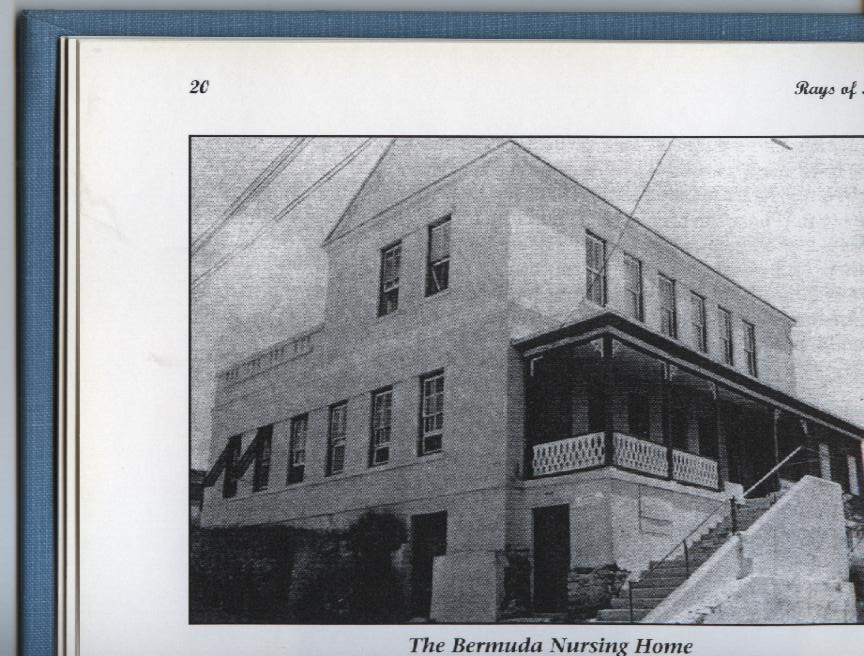
There is a vast story behind the struggle of some of the first Black nurses in Bermuda. We highlight this story in our Nurses exhibit at the Bermudian Heritage Museum and invite you to come and learn all about it. It is recorded that no hospital existed here in Bermuda other than Military facilities and the Asylum (now know as the Wellness Centre) until the Cottage Hospital opened its doors in Happy Valley Road in Pembroke on 1st. March 1894. The Hospital was enlarged several times and it had its financial challenges. This service lasted until 1920 when King Edward V11 memorial Hospital opened its doors. Once this took place it left many poor and sick people in the underlying neighbourhoods without ready medical services available to them. Dr. A. G. Pentreath a Doctor of Divinity was disturbed by this and felt something should be done about it. It was he who got the Friendly Societies involved in establishing a Nurses Association and building the Cottage hospital. Here nurses could be trained and go into the homes of the sick and give the much needed attention. Bermuda had qualified nurses as early as 1855 and they were in the struggle for equality to practice their trade in their own country. Some 20th century nurses who applied their trade were: Eliza Jane Lusher and Catherine Watson. Nurse Watson became the first Bermudian Nurse to work at the Bermuda Asylum which changed it’s name to St. Brendan’s and is now known as the Wellness Institute. The first permanent appointed Matron of the Nursing Home was Laurette I Williams R.N. the daughter of Solomon J. Smith. It was not easy for our nurses to obtained qualifications in their fields and were still refused a job at the hospital. Yet they continued to fight on . For centuries the greater portion of nursing in the Island was carried on by black nurses, including the breast-feeding of other women’s children Q ( Mind the Onion Seed ) Nellie Musson. Many Black nurses followed in the foot steps of their grandparents it was a noble profession . The nursing profession wasn’t the only area where our people were denied . Learn of the difficulty the first black pharmacist Dr. Olivia Tucker had in trying to apply her trade here in Bermuda. It was so bad she spent most of her life overseas working and receiving honours in several other countries but was never acknowledged in her own homeland. My aim is to research and bring to you our history no matter how painful. It is important that we learn of the struggle that got us to this point so we can move on. These were our heroes who endured much for us . The least we can do is learn of them and hold their banners high.


Historical Facts
First Election contested by a party
The first time a political party put up a a slate of candidates in a Bermuda election was in 1963, when the new Progressive Labour Party-Bemuda’s first polical party- put up nine candidates, six won seats, prompting the formatioin of the United Bermuda Party the following year.
The 1968 election was the first election contested entirely along party lines.
THE FIRST WOMEN MP’s
Women were finally granted the right to vote in 1944. The first women MP’s were Hilda Aitken and Edna Watson, who were elected in 1948.
MOST VOTES
A few landowners had up to 36 votes each under the old property vote system.
After decades of being effectively denied the vote by restrictive propety franchise, black Bermudians’ efforts to win basic democratic rights began to show fruit as three remarkable me appeared on the political scene.
Dr. E. F Gordon, W. L. Tucker and Dr. Roosevelt Brown led the fight for Universal Adult Suffrage.
The Bermudian Heritage Museum
Our History, Our Heritage
Just a stones throw away from the beautiful Somer’s Gardens stands a majestic building overlooking the serene blue waters of historic St. Georges.
It’s the Bermudian Heritage Museum. As you step in to view our museum, our knowledgeable guides welcome you with a smile and warm hello. When you leave our museum, you will leave knowing you have “opened a door to the past and welcomed our heritage’ into your heart.
 bermudaheritagemuseum